 Comparison
Which 3D Ultrasound Providers Give the Most Realistic Baby Images?
Last Updated: November 26, 2026
Quick Summary
No provider can guarantee the most realistic baby images, because results depend on the baby's position, gestational age and amniotic fluid as much as on equipment. Independent side-by-side comparisons of US 3D ultrasound providers are not available, so an evaluation should focus on criteria you can verify yourself.
- Fetal position is the most common reason a session produces a poor face shot.
- 3D, 4D, 5D and HD Live labels are not standardized and do not measure image quality.
- Ask providers for unedited sample images from typical sessions, not only their best photos.
- Get the re-scan and refund policy in writing before paying any deposit.
- Elective scans are non-diagnostic and do not replace regular prenatal care.
Table of Contents
- Which 3D Ultrasound Providers Offer the Most Realistic Baby Images?
- 3D vs. 4D vs. 5D Ultrasound: What the Difference Means for Image Realism
- What Actually Affects How Clear a Baby's Face Looks
- Comparing Providers: Criteria That Matter More Than Marketing Claims
- Best Time for a 3D Ultrasound and How to Get the Best 3D/4D Images
- What 3D Ultrasound Costs and How to Compare Packages
- Booking Your Session at BabyView3D in Arlington
- Frequently Asked Questions
Which 3D Ultrasound Providers Offer the Most Realistic Baby Images?
No provider can guarantee the most realistic baby images, because image quality depends on the baby's position, gestational age and amniotic fluid as much as on the equipment. Independent, side-by-side image comparisons of US providers are not available, so any ranking of "most realistic" would be unsupported. What we can do is explain what drives realism and how to evaluate a provider yourself.
A clear face depends on conditions in the womb, not only on the machine in the room, and expectant parents who understand that tend to approach their session with realistic expectations.
Many providers across the country advertise 3D, 4D, 5D or HD Live imaging. Such claims are marketing claims, so treat them as starting points for questions, not as proof of results. Ask each provider how their sessions handle the factors covered below.
3D vs. 4D vs. 5D Ultrasound: What the Difference Means for Image Realism
Many US elective-imaging providers advertise 3D, 4D, 5D or HD Live, but the labels are not standardized and they do not map to a single image-quality scale. Here is what each term actually describes, and what it does not.
3D ultrasound builds a three-dimensional still image from a series of two-dimensional slices. The machine renders surface shape and depth, so you see the face as a sculpted form rather than a flat cross-section. The output is a still image, usually a print or digital file.
4D ultrasound is 3D imaging played over time. The same volume data is captured repeatedly and displayed as motion, so you can watch the baby swallow, yawn or move a hand. The realism of a 4D clip depends on frame rate and on how steadily the baby stays in view.
5D and HD Live are not separate imaging physics. They are rendering and lighting modes applied to 3D/4D volume data. HD Live, a term associated with GE ultrasound systems, adds adjustable lighting and shading to make the surface look softer. "5D" is used loosely by some providers to mean an HD-style render, sometimes with added color or effects. Two providers can both say "5D" and produce very different images, because the label describes the look, not the underlying scan quality.
What the labels do not tell you:
- Resolution and probe quality. A newer system with a high-frequency probe can resolve finer facial detail than an older system using the same "5D" label.
- Operator technique. The person scanning controls probe angle, gain and the moment of capture. A skilled operator on modest equipment often beats an inexperienced operator on a premium machine.
- The baby's cooperation. No rendering mode can recover a face that is turned toward the placenta or pressed against the uterine wall.
A practical way to test a provider's claims is to ask for unedited sample images from sessions at the gestational window they recommend for you, not just their best-ever photo. Ask whether the samples were captured on the same equipment and rendering mode you would receive. Promotional galleries often show only the best sessions; a provider who will share a typical session, including a blocked-face result, is giving you more useful information.
Watch out: a provider who cannot explain the difference between their 3D and 5D modes, or who implies that a higher number guarantees a more realistic face, is selling a label rather than a result.
What Actually Affects How Clear a Baby's Face Looks
Gestational age matters most. Earlier in pregnancy, babies are often too small and the face is not yet fully formed. Later, the baby may be positioned with the face against the placenta or spine.
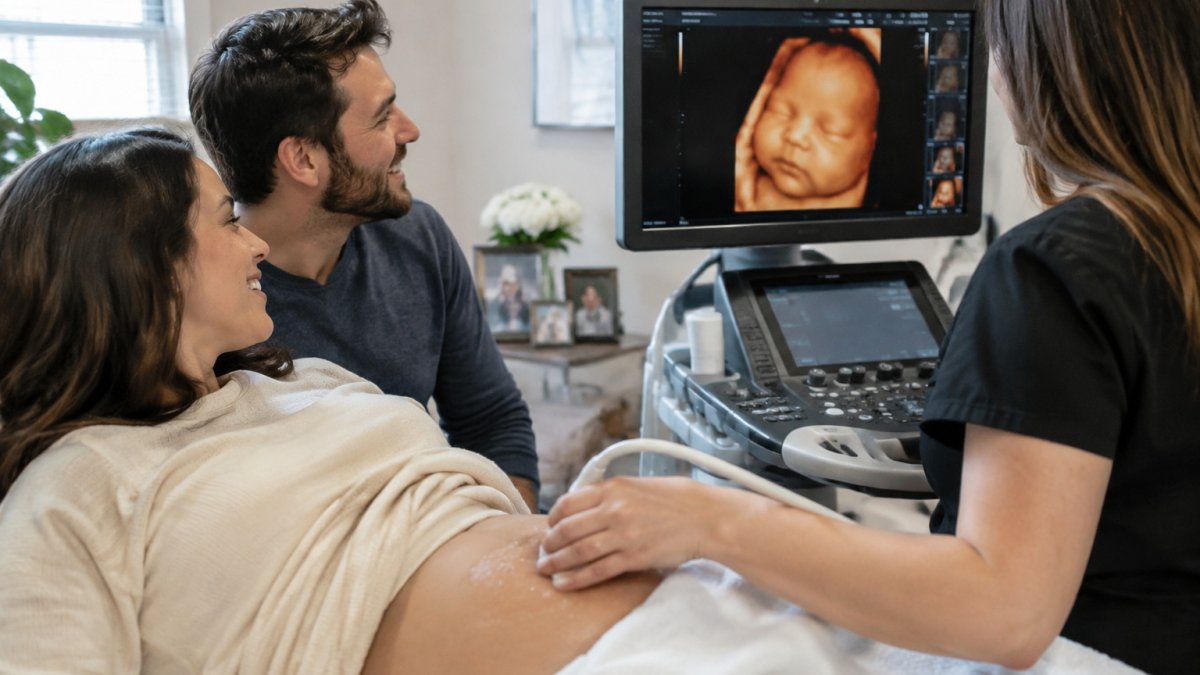
Fetal position is the most common reason a session gets a poor face shot. Amniotic fluid levels and the mother's body composition also change what the probe can reach. None of these can be controlled by the provider, which is why a good provider explains them before the appointment instead of promising a perfect picture.
Equipment and operator skill still count. Experienced operators can adjust settings and probe angle to work around position, but no technique guarantees a clear view of the face at every appointment.
Comparing Providers: Criteria That Matter More Than Marketing Claims
The US elective-ultrasound market includes independent studios, mobile services and add-on scans at boutique clinics, and their websites tend to use the same adjectives. To compare them on substance, build a shortlist and score each provider against the criteria below.
1. Equipment and rendering mode. Ask which ultrasound system and probe the studio uses and which rendering mode (3D, 4D, HD Live or a "5D" label) is included in the package you are considering. Equipment generations differ in resolution, and a provider should be able to name the system without deflecting.
2. Operator credentials and experience. Elective scans are often performed by sonographers. Ask whether the person scanning holds a recognized credential and how many elective sessions they perform in a typical week. Experience shows up in how quickly an operator can work around a poor fetal position.
3. Session length and re-scan policy. A 15-minute session leaves little room to wait for the baby to move; 30 minutes or more gives the operator time to try different angles. Ask what happens if the face is blocked: does the provider offer a free or discounted return visit, and within what window? Get the policy in writing before you pay.
4. Deliverables. Confirm exactly what is included: number of printed photos, digital files, video clips, and whether you receive them the same day. A package price means little without knowing the output.
5. Pricing transparency. Package prices vary by format, session length and keepsakes, and depend on quantity, dates and delivery. A provider that publishes its prices and inclusions is easier to compare than one that quotes only by phone. Ask whether there is a deposit and whether it is refundable.
6. Guest policy and comfort. Ask how many guests can attend, whether the room has a large display, and whether children are welcome. These details affect the experience more than a marketing photo does.
7. Safety and scope statements. A trustworthy provider states plainly that elective imaging is non-diagnostic, that it does not replace prenatal care, and how it handles an incidental finding. Keepsake ultrasound performed without a medical need carries risks, including exposure without medical benefit and the possibility of false reassurance (the FDA). A provider who acknowledges this is more credible than one who markets the scan as a checkup.
8. Reviews with dates and sources. Read recent reviews from independent sites rather than testimonials on the provider's own site, and look for patterns about image clarity, punctuality and how staff handled a poor scan. Note the dates, since ownership and equipment change.
Score each shortlisted provider on these eight points and keep the notes. Our FAQ answers common questions about what sessions include and how they work. A provider that answers clearly on equipment, credentials, re-scan policy and scope is usually a better bet than one that leads with dramatic sample photos.
Watch out: be cautious of any provider that guarantees a clear face shot, discourages you from keeping your regular prenatal appointments, or will not put its re-scan and refund policy in writing.
The article suggests scoring each provider against a set of criteria rather than relying on marketing claims. Here is a quick summary of those criteria.
| Criterion | What to ask | Why it matters |
|---|---|---|
| Equipment and rendering mode | Which system, probe and mode is included | Generations differ in resolution |
| Operator credentials | Recognized credential and sessions per week | Experience helps work around position |
| Session length and re-scan policy | 30+ minutes; re-scan terms in writing | Time allows different angles |
| Deliverables | Printed photos, digital files, video clips | Package price means little without output |
| Pricing transparency | Published prices, deposit and refund terms | Easier to compare packages |
| Safety and scope statements | Acknowledges non-diagnostic nature | Signals credibility |
| Reviews with dates and sources | Independent, recent reviews | Ownership and equipment change over time |
Best Time for a 3D Ultrasound and How to Get the Best 3D/4D Images
Timing depends on what you want from the session. Earlier sessions focus on seeing the developing baby. Later sessions can offer more room for facial detail, though position still decides the outcome.
To give your session the best chance:
- Book early enough to fit the recommended weeks for your package.
- Drink water beforehand, since hydration can affect fluid levels.
- Arrive with a clear idea of which images you want.
- Ask the operator to explain the baby's position before the session starts.
Check the booking rules before you schedule so you know what a rescheduled or missed session would cost you. Review our booking policy for the current terms.
What 3D Ultrasound Costs and How to Compare Packages
We do not publish a price comparison here, because the research we reviewed did not verify prices for US providers, and any figure we gave could be wrong. Pricing generally depends on the imaging format, session length, number of keepsake images or videos, and the gestational week you book.
When comparing packages, line up what each one includes: the imaging format, the time in the room, whether family members can attend, and whether printed or digital keepsakes are part of the price. A lower price with fewer keepsakes may cost more per image than a higher-priced package.
Current package details are on our store page, where you can compare options side by side.
Booking Your Session at BabyView3D in Arlington
If you are in the Arlington, Texas area and want to see what a session looks like, our services page describes the imaging options we offer. You can also check our Arlington location details to confirm the address and visit information before you book.
Bring the questions from this guide. A good provider will answer them plainly, and that tells you more about image quality than any sample photo.
Get a clearer view of your baby with BabyView3D, where experienced operators explain what to expect before your session begins.
Frequently Asked Questions
Do babies look like their 3D ultrasound pictures?
Not always. A 3D ultrasound shows the baby's face from the position it was in during the session, and the image can look softer or different from a newborn. Fetal position, gestational age, amniotic fluid and maternal body characteristics all affect how clearly the face appears. Even advanced 3D or HD Live equipment cannot guarantee a clear facial view at every appointment, so treat the images as a keepsake of that moment rather than a preview of the baby's final appearance.
How many weeks pregnant is best for a 3D scan?
Many providers recommend a window in the later second trimester or early third trimester, when there is enough fetal growth and fluid for a clearer view. Earlier sessions focus more on seeing the developing baby, while later ones often produce more detailed facial images. Recommendations vary by provider and by the family's goals, so ask which pregnancy weeks each package is designed for before booking.
What is the difference between 3D, 4D, and 5D ultrasound?
2D ultrasound shows flat cross-sectional images. 3D creates a still three-dimensional rendering of the baby, while 4D adds real-time movement. 5D or HD Live is a marketing term used by many providers for enhanced, more lifelike rendering with added lighting and depth. The term has no single standardized meaning, so ask a provider exactly what imaging technology and settings they use.
How do I choose a reputable 3D ultrasound provider?
Check the experience and credentials of the ultrasound professional before booking, and ask which imaging options are offered. Confirm session length, whether family members are welcome, and whether printed or digital keepsakes are included. Ask what happens if the baby's position does not allow clear images. A transparent provider will explain that image quality is not guaranteed and will describe the session's non-diagnostic scope.