 Ultimate guide
How to Judge If a 3D Ultrasound Is Medically Safe
Last Updated: November 17, 2026
Quick Summary
Diagnostic ultrasound has a long safety record in pregnancy, but 3d ultrasound safe depends on purpose, operator, and duration. Medically ordered scans are considered safe when appropriately conducted, while elective keepsake sessions raise unresolved questions about nonmedical exposure.
- A 2023 review found harmful biological effects in humans not established for diagnostic and research use.
- The FDA advises limiting ultrasound to medical purposes and trained health care professionals.
- Keepsake concern is nonmedical exposure without medical benefit, not a claim all ultrasound is unsafe.
- Ask providers who performs the scan, who reads the images, and how long the session runs.
- Discuss any elective scan plans with your clinician before booking, especially for higher-risk pregnancies.
Table of Contents
- Are 3D Ultrasounds Medically Safe? What the Research Says
- 2D, 3D, and 4D Ultrasound: What Each One Actually Does
- Medical Ultrasound vs. Keepsake Scans: Why the Purpose Matters
- Are Keepsake Ultrasounds Safe for Pregnancy?
- Can Too Many Ultrasounds Harm the Baby?
- Why Would a Doctor Order a 3D Ultrasound?
- Are 3D Ultrasounds Covered by Insurance?
- Booking a Safe, Trained-Provider Session in Arlington
- Frequently Asked Questions
Are 3D Ultrasounds Medically Safe? What the Research Says
Are 3D ultrasounds medically safe? Diagnostic ultrasound has a long record of safety in pregnancy, and a 2023 review concludes that harmful biological effects in humans have not been established for diagnostic and research use. Quarato et al., "A Review on Biological Effects of Ultrasounds: Key Messages for Clinicians", 2023 That conclusion is about the technology in appropriate medical settings, and it does not automatically extend to every keepsake session.
BabyView3D writes this guide for families weighing an elective 3D or 4D scan, and the distinction matters. Safety depends on why the scan is done, who performs it, and how long it lasts. The sections below separate what the evidence supports from what remains a judgment call.
The scientific picture is reassuring but not unconditional. A 2011 review states there is no reason to withhold diagnostic scanning during pregnancy based on available evidence, provided scanning is conducted appropriately. G. ter Haar, "Ultrasonic imaging: safety considerations", 2011 The phrase "appropriately conducted" carries real weight, and it frames everything that follows.
The article's key safety points can be scanned at a glance:
| Source or point | What it says | Scope |
|---|---|---|
| 2023 review (Quarato et al.) | No established harmful biological effects in humans | Diagnostic and research use |
| 2011 review (ter Haar) | No reason to withhold diagnostic scanning | Appropriately conducted scanning |
| FDA | Limit ultrasound to medical purposes | Trained health care professionals |
| AIUM | Medical diagnostic use is generally considered safe | Some studies report possible effects |
| Keepsake scans | Concern is nonmedical exposure without medical benefit | Not a claim all ultrasound is unsafe |
2D, 3D, and 4D Ultrasound: What Each One Actually Does
Two-dimensional ultrasound produces cross-sectional images, and it remains the standard for prenatal monitoring. Three-dimensional imaging combines many slices into a rendered picture of the face or body. Four-dimensional imaging adds real-time movement to that 3D view.
The difference matters for safety because the imaging mode does not change the underlying sound-wave exposure as much as the scan length and purpose do. A 3D or 4D session may run longer than a routine check, since the sonographer may be working to capture a clear angle. That extra time is where the keepsake format raises questions.
Medical Ultrasound vs. Keepsake Scans: Why the Purpose Matters
A medical ultrasound answers a clinical question, and the operator uses only as much exposure as the question requires. A keepsake scan has no clinical question, which is why the FDA advises that ultrasound be limited to medical purposes and trained health care professionals. UT Southwestern Medical Center, "Why to avoid 'keepsake' 3-D and 4-D ultrasounds" The concern is nonmedical exposure without a medical benefit, not a claim that all ultrasound is unsafe.
The American Institute of Ultrasound in Medicine makes a similar point: ultrasound energy can produce biological effects, and some studies have reported possible effects during pregnancy, even though medical diagnostic use is generally considered safe. American Institute of Ultrasound in Medicine, "Prudent Use and Safety of Diagnostic Ultrasound in Pregnancy" Both statements can be true at once, and that tension is the core of the keepsake debate.
Are Keepsake Ultrasounds Safe for Pregnancy?
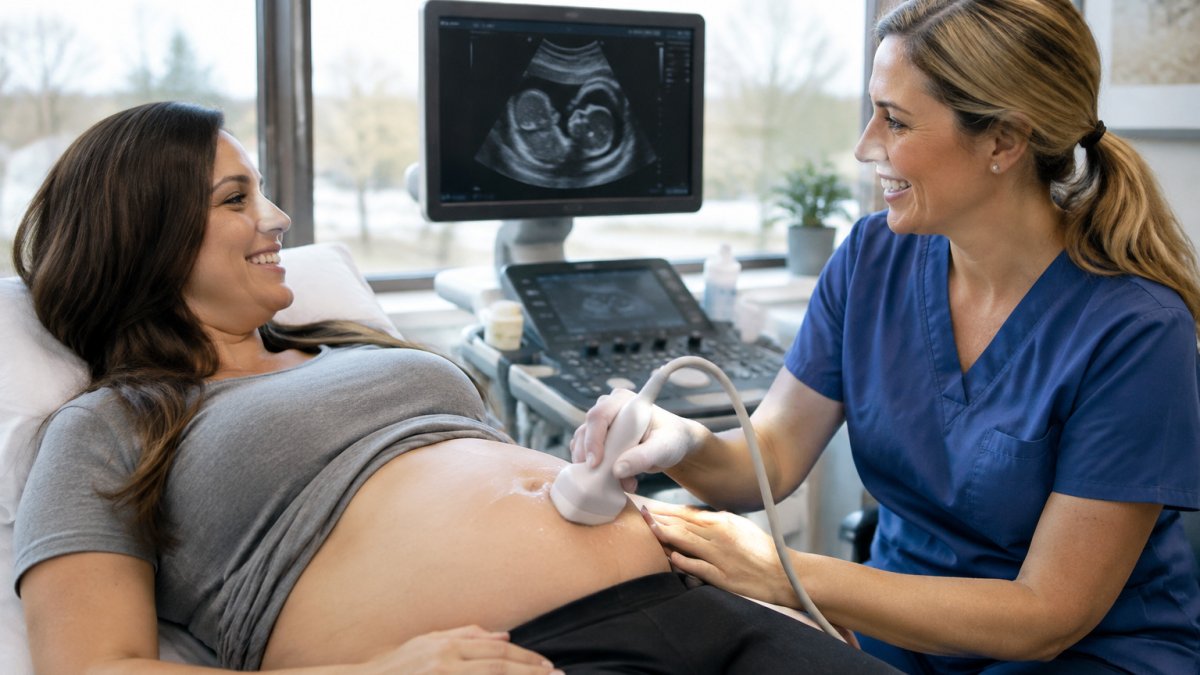
Keepsake ultrasounds sit in a different category from diagnostic imaging, and the nonmedical use itself carries unresolved questions. The FDA has long cautioned against nonmedical ultrasound, including keepsake videos and photos, because it is a form of energy that can affect tissue and should be used only when there is a medical reason and by trained health care professionals. U.S. Food and Drug Administration, "Ultrasound Imaging" The American Institute of Ultrasound in Medicine takes a similar position in its prudent-use guidance, recommending that ultrasound be performed for a medical indication, by qualified personnel, at the lowest exposure that answers the clinical question. American Institute of Ultrasound in Medicine, "Prudent Use and Safety of Diagnostic Ultrasound in Pregnancy"
That framing separates two questions readers often merge. Is the sound energy itself dangerous at diagnostic levels? The evidence to date does not establish harm in humans from appropriately conducted diagnostic scanning. Is an elective, nonmedical session with no clinical oversight safe in the same sense? That is a different question, and no large study has isolated keepsake sessions to answer it. The uncertainty runs in both directions: it is not proof of danger, and it is not proof of zero risk.
A practical way to think about it is exposure dose. Ultrasound safety discussions center on how long and how often the beam is on, and trained sonographers keep exposure low by limiting dwell time over sensitive areas.
If you are considering an elective scan, evaluate the provider before you book. A neutral checklist:
- Who performs the scan. Ask the provider about the credentials and experience of the ultrasound professional before booking.
- Who reads the images. A keepsake scan is not a diagnostic exam. Ask the provider whether any clinician reviews the images.
- How long the session runs. Ask for the scheduled duration before booking.
- What the provider will not do. Ask the provider to confirm that the scan is for bonding and is not a diagnostic exam.
- Referral procedure. Ask what happens if the operator sees something unusual.
Watch out: a provider who promises to "check the baby is healthy" or who markets unlimited or very long sessions is signaling that the scan is being framed as medical when it is not, and that framing is where the real safety concern lives.
If an elective scan does turn up a possible concern, treat it as a prompt to call your obstetric clinician, not as a diagnosis. Keepsake images are not a substitute for a diagnostic exam, and your clinician can order the appropriate follow-up. Families with higher-risk pregnancies, prior abnormal findings, or clinician-directed monitoring should make any elective scan decision with their prenatal care team. Before booking, discuss your plans with your clinician and keep your scheduled medical ultrasounds on track.
Can Too Many Ultrasounds Harm the Baby?
Repeated or prolonged exposure is the variable most worth watching, and it is where the safety conversation gets concrete. Ultrasound is not radiation, so the comparison to X-rays does not apply. The concerns studied in the literature are biological effects of the sound energy itself, chiefly heating at the beam's focus and mechanical effects. Professional guidance supports medically indicated scanning during pregnancy and emphasizes keeping exposure short and purposeful. The open question is what happens with exposure that is longer, more frequent, or not tied to a medical reason.
That is why the principle of as low as reasonably achievable (ALARA) governs obstetric ultrasound. The operator uses the lowest output and shortest time that answers the clinical question, and stops when the question is answered. A routine anatomy scan is built around that principle. A series of elective sessions booked for reassurance or entertainment is not, because there is no clinical question to bound the exposure.
Families who are anxious sometimes book multiple elective scans in a row. That pattern deserves a conversation with a clinician, both for the exposure question and for the anxiety itself.
What the evidence can and cannot establish is worth stating plainly. Research supports the general safety of diagnostic ultrasound in pregnancy when appropriately conducted. Research does not establish that any specific number of elective sessions is safe, because elective keepsake use has not been studied in large controlled trials. The defensible position is that unnecessary exposure should be avoided because there is no benefit to offset even a small uncertain risk, not because harm has been demonstrated.
Higher-risk pregnancies change the picture in a specific way. If you have a complication, a prior abnormal finding, or a clinician-directed monitoring schedule, the number and timing of ultrasounds is a clinical decision, and more frequent scanning may be medically appropriate. In that situation the question is not "how many is too many" in the abstract but whether each scan has a clinical purpose. Ask your prenatal care team why a scan is being ordered and what finding it is meant to detect, and raise any elective scan plans with them before booking so the exposure picture is coordinated rather than duplicated.
Why Would a Doctor Order a 3D Ultrasound?
A physician may order a 3D ultrasound when a clinical question requires a detailed view of fetal anatomy. In that setting, the scan serves a diagnostic purpose. That is different from an elective keepsake session.
If your doctor recommends a specialized scan, follow that recommendation and ask what it is meant to show. Ask how the findings will change your care.
Are 3D Ultrasounds Covered by Insurance?
Insurance generally covers ultrasounds ordered for a medical reason, while elective keepsake sessions are usually paid out of pocket. Coverage rules vary by plan, so check with your insurer before assuming any portion of a scan is covered. For current policy details, contact your insurance provider directly.
BabyView3D's FAQ page answers common questions about pricing and what to expect before you book.
Booking a Safe, Trained-Provider Session in Arlington
When you look for an elective scan in Arlington, ask about the professional's credentials and how long the session will run before booking. You can review the options on the services page and find the business's location on the locations page.
Check the booking policy for scheduling rules and any terms that apply before you commit. Keep your prenatal care on schedule, and treat the keepsake as a bonding experience rather than a medical check.
Choosing a keepsake session is a personal decision, and the evidence supports caution rather than alarm. At BabyView3D, we help families in Arlington book trained, unhurried 3D and 4D sessions designed around bonding, and we encourage you to talk with your prenatal provider first. Book your session with BabyView3D to see your baby in stunning 3D.
Frequently Asked Questions
What are the risks of 3D ultrasound?
Diagnostic ultrasound has been described in a 2023 review as safe, with no harmful biological effects in humans established. The FDA advises limiting ultrasound to medical purposes and trained health care professionals, because the concern with keepsake scans is nonmedical exposure without a medical benefit. Exposure is generally kept low by brief scan times and appropriate equipment settings. Risk depends on how and why the scan is done, so ask your prenatal provider about any concerns before booking an elective session.
Are keepsake ultrasounds safe?
Keepsake ultrasounds are not medically indicated and are not a substitute for prenatal care. The American Institute of Ultrasound in Medicine notes that ultrasound energy can produce biological effects, and some studies report possible effects during pregnancy, so it should not be described as entirely risk-free. Keep sessions short, avoid repeated scans, and check with your obstetrician before booking.
Are 3D ultrasounds accurate for determining a baby's appearance or sex?
Image quality depends on gestational age, fetal position, and amniotic fluid, so even advanced imaging cannot guarantee a clear view of the baby's face in every session. At BabyView3D, we explain that image quality is not guaranteed rather than promising a specific result. Elective 3D scans are for bonding and entertainment, and they are not a reliable diagnostic tool for sex determination or fetal appearance.
Are 3D ultrasounds safe for the baby?
Diagnostic ultrasound is widely used in pregnancy, and a 2011 review found no scientific reason to withhold diagnostic scanning when it is conducted appropriately. The risk question centers on unnecessary, prolonged, or unsupervised keepsake scans rather than the technology itself. Choose an experienced, credentialed ultrasound professional, keep the session brief, and discuss elective imaging with your prenatal care team if you have a higher-risk pregnancy.